Position Before Technique: Why Body Positioning Matters in First Responder Safety
When people think about preparing first responders for physical encounters, the focus often turns to techniques: how to escape a grab, control a person, disengage, or respond when someone becomes aggressive.
Those skills have a place. But first responder safety often begins much earlier, with where you are standing, what is around you, and how you position yourself in relation to the person you are dealing with.
Good positioning can create time, improve communication, preserve options and make it easier to disengage if a situation begins to deteriorate. Poor positioning can remove those options before physical contact ever occurs.
First Responder Safety Starts Before Physical Contact
One of the most valuable opportunities to reduce risk happens before an encounter becomes physical.
Consider the difference between standing directly in front of someone in a confined space and maintaining a position that provides appropriate distance, a useful angle and access to an exit.
Nothing physical has happened in either situation, but the options available to the responder can be very different.
Positioning should not be about appearing confrontational or preparing for a fight. It is about maintaining awareness of your surroundings and avoiding unnecessary disadvantages while continuing to communicate and provide care or assistance.
For Ontario paramedics, this concept is reflected directly in the province’s Basic Life Support Patient Care Standards. The standards require paramedics to assess the environment, identify routes of access and egress, ensure the environment is safe, and give particular attention to personal safety when dealing with violent or aggressive patients.
Distance Creates Time and Options
Distance is not simply about staying far away from someone. It is about recognizing how distance affects the amount of time available to observe, communicate and respond.
As distance closes, the amount of time available to recognize and react to sudden movement decreases.
Whenever circumstances allow, responders can consider whether their position gives them enough space to communicate effectively while still maintaining options if behaviour changes.
The appropriate distance will vary. A paramedic providing patient care may need to work much closer than someone conducting an initial assessment. A police officer, healthcare worker or security professional may face entirely different environmental constraints.
The principle remains the same: understand what your position allows you to do before you need to do it.
Angles Can Be More Important Than Strength
Positioning is also about angles.
Standing directly in front of someone may place a responder directly in the path of forward movement. A small change in angle can sometimes provide a better view of the person’s hands, improve movement options and make it easier to create distance.
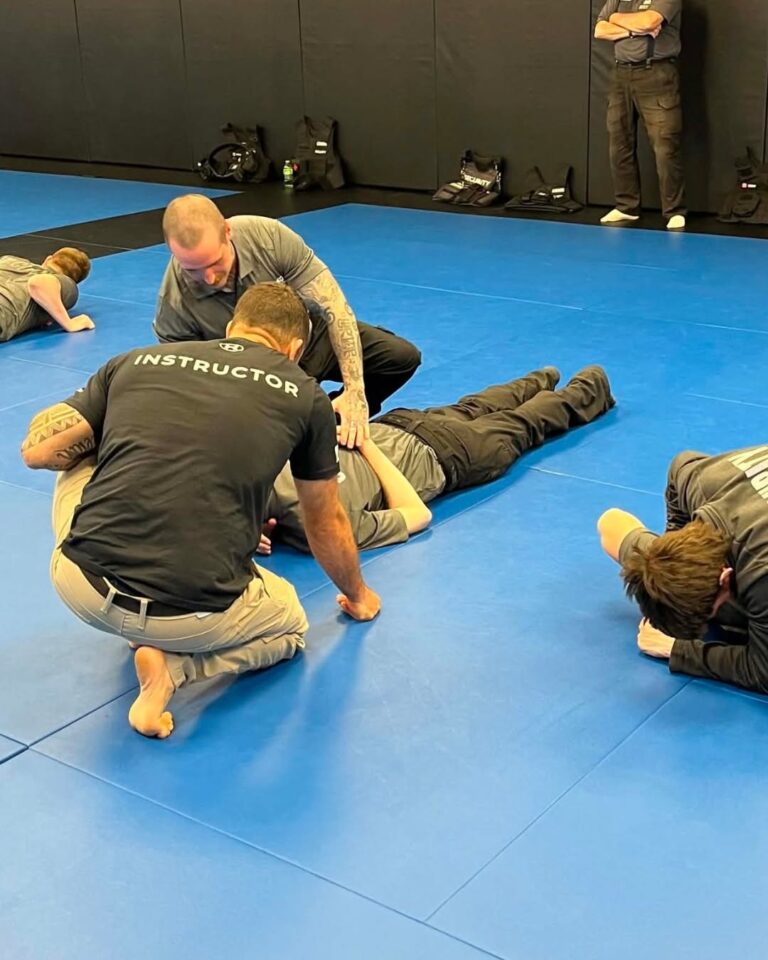
If physical contact becomes unavoidable, positioning becomes even more important.
Trying to overcome resistance using strength alone can quickly become exhausting and unpredictable. Position, leverage and movement can allow responders to manage physical contact more efficiently while reducing unnecessary force.
This is why defensive control training should not simply become a collection of isolated techniques.
Knowing a technique and being prepared to apply it under pressure are not always the same thing.
Responders need to understand why a position is advantageous, how to recognize when that advantage is disappearing, and when the better decision is to reposition or disengage.
The Environment Is Part of the Encounter
First responders rarely work in open training spaces.
They work beside stretchers, inside ambulances, between vehicles, in hallways, bedrooms, stairwells, hospitals, public spaces and countless other environments they cannot control.
Furniture, walls, doorways, equipment and other people can all change the encounter.
A responder who unknowingly allows someone to position themselves between the responder and the only exit may have fewer options if behaviour suddenly changes.
The opposite can also be true. Recognizing an exit, maintaining mobility and avoiding unnecessary confinement can provide options without changing the tone of the interaction at all.
Environmental awareness should therefore be part of positioning, not something considered separately.
Good Positioning Can Support De-escalation
De-escalation is often discussed primarily as communication.
Communication is critical, but the physical environment surrounding that conversation also matters.
Maintaining appropriate space can reduce pressure on both parties. Avoiding unnecessarily confrontational positioning can help keep an interaction from feeling more adversarial. Team members can also position themselves in ways that provide support without unnecessarily surrounding or crowding someone.
This creates an important connection between communication and defensive skills.
They should not exist as two completely separate parts of training.
Awareness, positioning, communication, movement, disengagement and defensive control should support one another as circumstances change.
Position Before Technique
Techniques are easier to teach because they have a clear beginning and end.
Real encounters rarely do.
A responder may have only seconds to recognize that someone’s behaviour has changed, that distance is disappearing, or that their position has become unsafe.
Training should therefore help personnel recognize those moments earlier.
The objective is not to turn every interaction into a tactical problem. It is to develop habits that allow frontline professionals to communicate, provide care and perform their duties while maintaining awareness of the options available to them.
When physical skills are eventually required, those same principles continue to matter.
Position creates options. Options create opportunities to make better decisions.
And whenever possible, those decisions should begin before physical contact ever occurs.